Zero-Knowledge Proofs Meet AI: Private Computation's Next Era
An AI model can now prove, mathematically, that it produced a result correctly — without showing anyone the data it used, the model's internal weights, or anything else it would normally have to expose to be trusted. That combination didn't really exist a few years ago. In 2026, it's quietly becoming infrastructure.
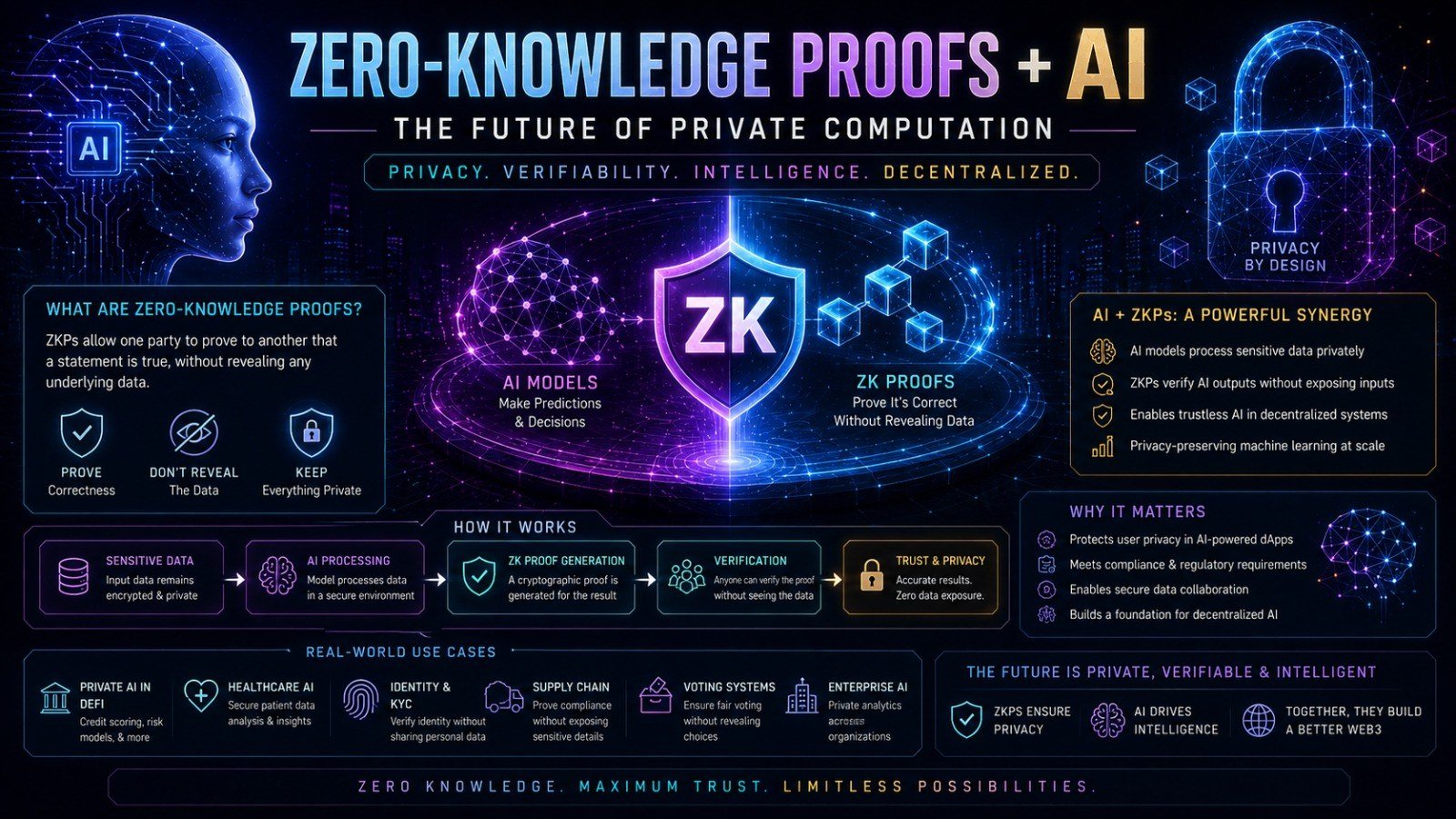
Zero-knowledge proofs (ZKPs) are a cryptographic tool that lets one party prove a statement is true without revealing why it's true. The classic example: proving you know a password without ever transmitting the password itself. Applied to machine learning, this becomes zkML — zero-knowledge machine learning — and it solves a tension that's become genuinely hard to ignore as AI handles more sensitive decisions: blockchains are transparent by design, but the data feeding an AI model, and often the model itself, usually isn't supposed to be.
The problem this actually solves
Today's neural networks are complex enough that even the people who built them often can't fully explain a specific decision. That opacity used to be a tolerable cost of doing business. It isn't anymore: regulators want auditable AI, enterprises want to outsource model training without handing over their data, and users increasingly want proof — not a promise — that an automated decision followed the rules it claimed to follow. The traditional way to verify an AI system did its job correctly is to re-run it and inspect everything, which is slow, expensive, and often impossible without seeing data you were never supposed to see in the first place. zkML replaces "re-run and inspect" with "check a short cryptographic proof," which can be verified in milliseconds without access to the original data or model.
How it actually works, without the math
A model trains the normal way, off-chain, on its own infrastructure. When it produces an inference — a prediction, a classification, a decision — the system also generates a compact cryptographic proof that the computation was carried out faithfully, using the correct version of the model, without tampering with the inputs. That proof, not the underlying data, is what gets published or submitted on-chain. Anyone — a regulator, a counterparty, a smart contract — can verify the proof checks out without ever seeing the sensitive material it's vouching for. It's sometimes described as "proof of computation rather than repetition of computation," which is a useful way to think about why it's so much cheaper to verify than to redo.
Where this is already running, not just theorized
Worldcoin's World ID is probably the most visible real-world deployment: it uses iris-scanning hardware combined with zero-knowledge proofs to verify that a person is a unique human being, without storing or revealing the biometric data itself. In DeFi, zkML is being explored for on-chain credit and risk scoring — letting a lending protocol act on an AI risk assessment without the underlying financial data ever touching the chain. Other active use cases include AI-scored NFT valuation, fraud detection that doesn't require exposing the transaction patterns it's trained on, and DAO governance tools where members can trust an AI's voting recommendation followed agreed-upon rules without auditing the model line by line. Toolkits like EZKL have made some of this practical for smaller, specialized models today, while research projects are explicitly working to extend proof generation toward larger language models.
The regulatory timing isn't a coincidence
The EU AI Act becomes fully applicable to high-risk AI systems in August 2026, and it requires those systems to maintain logs sufficient for after-the-fact auditing — while GDPR's "privacy by design" principle simultaneously pushes the other direction, toward minimizing what's exposed. Those two requirements are in genuine tension under a traditional logging model: full exposure satisfies the auditor and violates the privacy principle, and minimal logging does the reverse. Zero-knowledge audit frameworks offer a third option some researchers call query-scoped disclosure: the record of what happened exists and is immutable, but the actual content stays private unless a proof is generated specifically in response to a regulator's specific question. It's a genuinely new answer to an old problem, and it's arriving right as the regulation that needs it takes effect.
What's still genuinely hard
- Proving cost scales with model size. Generating a zero-knowledge proof for a small, specialized classifier is practical today. Doing it for a large language model is an active research problem, not a solved one.
- Circuit expressiveness is limited. Not every operation a neural network performs translates cleanly into the cryptographic "circuits" that zero-knowledge systems require, which constrains which model architectures are realistically provable right now.
- This is a trust layer, not a correctness guarantee. A zkML proof confirms a model ran as specified on the claimed inputs — it doesn't confirm the model itself is unbiased, accurate, or well-designed. Verifiable and correct are different properties.
Taking back control of what you expose
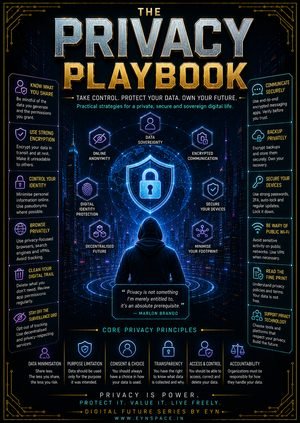
The Privacy Playbook
Zero-knowledge proofs are a glimpse of where data privacy is heading: proving things without exposing them. This book is the practical playbook for the privacy decisions you can actually act on today.
View this book →For the smart-contract layer that zkML proofs ultimately get verified on, Ethereum & Smart Contracts covers the programmable-money foundation this entire field is built on top of.