
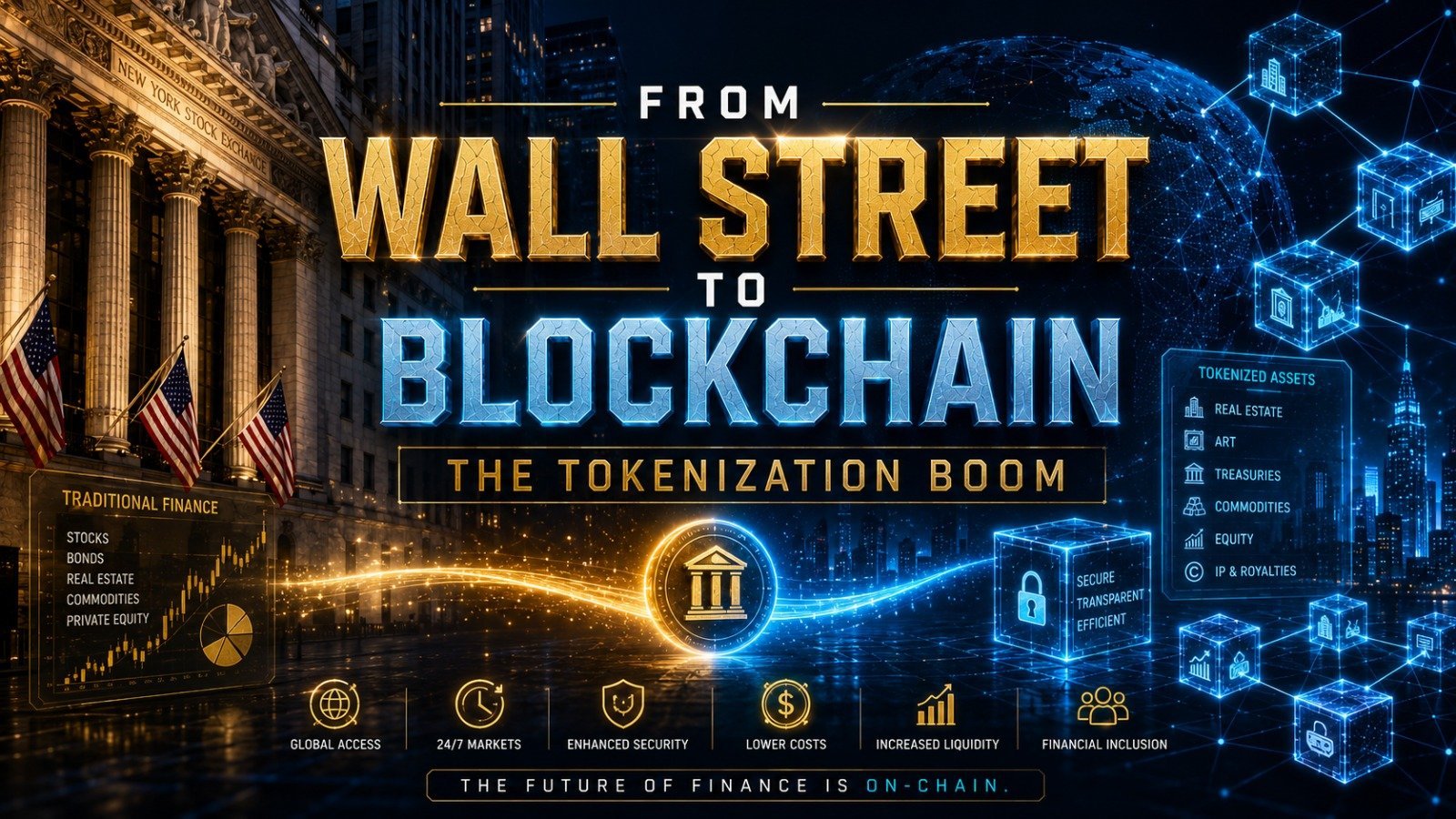
From Wall Street to Blockchain: The Tokenization Boom
Eighteen months ago, "tokenized Treasuries" was a niche term used mostly by crypto-native funds. In 2026, BlackRock, Franklin Templeton, Goldman Sachs, and the DTCC are all building on the same idea — and the on-chain numbers have moved faster than almost anyone forecast.
Real-world asset tokenization — taking something that already exists off-chain, like a Treasury bond, a bar of gold, or a share of private credit, and representing legal and economic ownership of it as a token on a blockchain — has quietly gone from an experimental sideline to a line item on the balance sheets of the institutions that run global capital markets. The pace of that shift is the part most people, including people who follow crypto closely, have missed.
The numbers nobody expected this fast
According to on-chain analytics firm RWA.xyz, the tokenized real-world asset market (excluding stablecoins) sat at roughly $5.4–5.8 billion at the start of 2025. By May 2026, it had crossed $33.7 billion — growth north of 400% in under a year and a half. Tokenized U.S. Treasuries did most of the early heavy lifting, climbing past $13 billion as institutions realized a blockchain-based Treasury fund could settle in seconds instead of days, distribute yield programmatically, and trade outside normal market hours.
What's more telling than the headline number is the spread. A year ago, this market was essentially one product category. By early 2026, six separate categories — Treasuries, private credit, commodities, corporate bonds, non-U.S. government debt, and institutional alternative funds — had each independently crossed the billion-dollar mark on-chain. A market concentrated in one asset type is one regulatory decision away from a serious setback. A market spread across six is a different, more durable thing.
What's actually being tokenized
Tokenized Treasuries and money-market funds remain the entry point for institutional capital, for an obvious reason: they're familiar, carry minimal credit risk, and the yield can be paid out automatically through a smart contract instead of a back-office process. BlackRock's BUIDL fund passed $2.4 billion in assets and, in February 2026, became the first regulated tokenized fund to trade directly on a decentralized exchange (Uniswap) — a genuinely new kind of bridge between traditional finance and crypto infrastructure. Franklin Templeton's competing fund, built on the same idea, passed $2.47 billion around the same time, and JPMorgan, Goldman Sachs, and BNY Mellon are now running similar products.
Tokenized gold and commodities turned out to be the sleeper category. Gold-backed tokens from issuers like Tether and Paxos drove $90.7 billion in trading volume in the first quarter of 2026 alone — more than all of 2025 combined. That's not speculative interest; it's gold buyers discovering that a token settles faster and fractionalizes more easily than a vault receipt.
Tokenized equities and private credit are the categories still finding their footing. Tokenized stock trading crossed $1 billion in March 2026 with over 185,000 holders — up from essentially zero in late 2024 — but still represents under 1% of conventional equity trading volume. The gap between "exists" and "matters at scale" is still wide here.
Why Wall Street is actually doing this
The honest answer is cost and speed, not ideology. Industry estimates put traditional securities issuance costs at 5–8% of the raise; tokenized issuance runs 1–3%. Settlement that used to take T+1 or T+2 can, on-chain, happen in the time it takes a block to confirm. And a tokenized fund share can be used as on-chain collateral instantly, something a paper share certificate simply cannot do. None of this required anyone at a major bank to believe in crypto as a cause — it just had to be cheaper and faster than what they were already doing, and by 2026 it clearly was.
The regulatory green light
2026 is also the year U.S. regulators stopped treating this as a gray area. On January 28, the SEC's Division of Corporation Finance, along with its Investment Management and Trading and Markets divisions, issued a joint statement confirming that a tokenized security is still a security under existing federal law — tokenization changes the format, not the legal obligations attached to it. In March, the SEC and CFTC followed up with a joint framework sorting digital assets into five categories, giving institutions a much clearer map of which rules apply to what. In Europe, the picture moved even further: as of March 30, 2026, the European Central Bank confirmed that distributed-ledger-based assets are eligible collateral for Eurosystem credit operations — the kind of unglamorous plumbing decision that quietly unlocks a great deal of institutional demand.
What this isn't, yet
It's worth being precise about scale here, in the same spirit as the rest of this series: evidence over hype. Global financial assets exceed $400 trillion. A $33.7 billion tokenized market, however fast-growing, is still well under 0.1% penetration. Secondary trading volume relative to the amount of value already tokenized remains low, meaning most tokenized assets today are held rather than actively traded — a sign that liquidity, the thing that actually makes a tokenized asset useful day-to-day, is still being built. The growth curve is real. The market is not yet anywhere close to mature.
Why this matters even if you don't trade
This is the part of crypto's story that rarely gets a headline, because it's not about price swings — it's about plumbing. If the trend lines hold, the way a Treasury bond or a fund share settles, gets used as collateral, and changes hands will look fundamentally different by the early 2030s than it did in 2020. That's a bigger, quieter shift than any single coin's price chart, and it's exactly the kind of institutional adoption story this series has been tracking since Book 1.

Go deeper
Institutional Bitcoin — Wall Street & the New Gold
How Bitcoin went from retail curiosity to corporate treasuries and ETFs — the same institutional shift driving the tokenization boom, examined book-length.
View this book →For the infrastructure side of this story — how blockchain creates value beyond any single cryptocurrency — Blockchain Beyond Bitcoin covers the broader landscape these tokenized products are built on.