
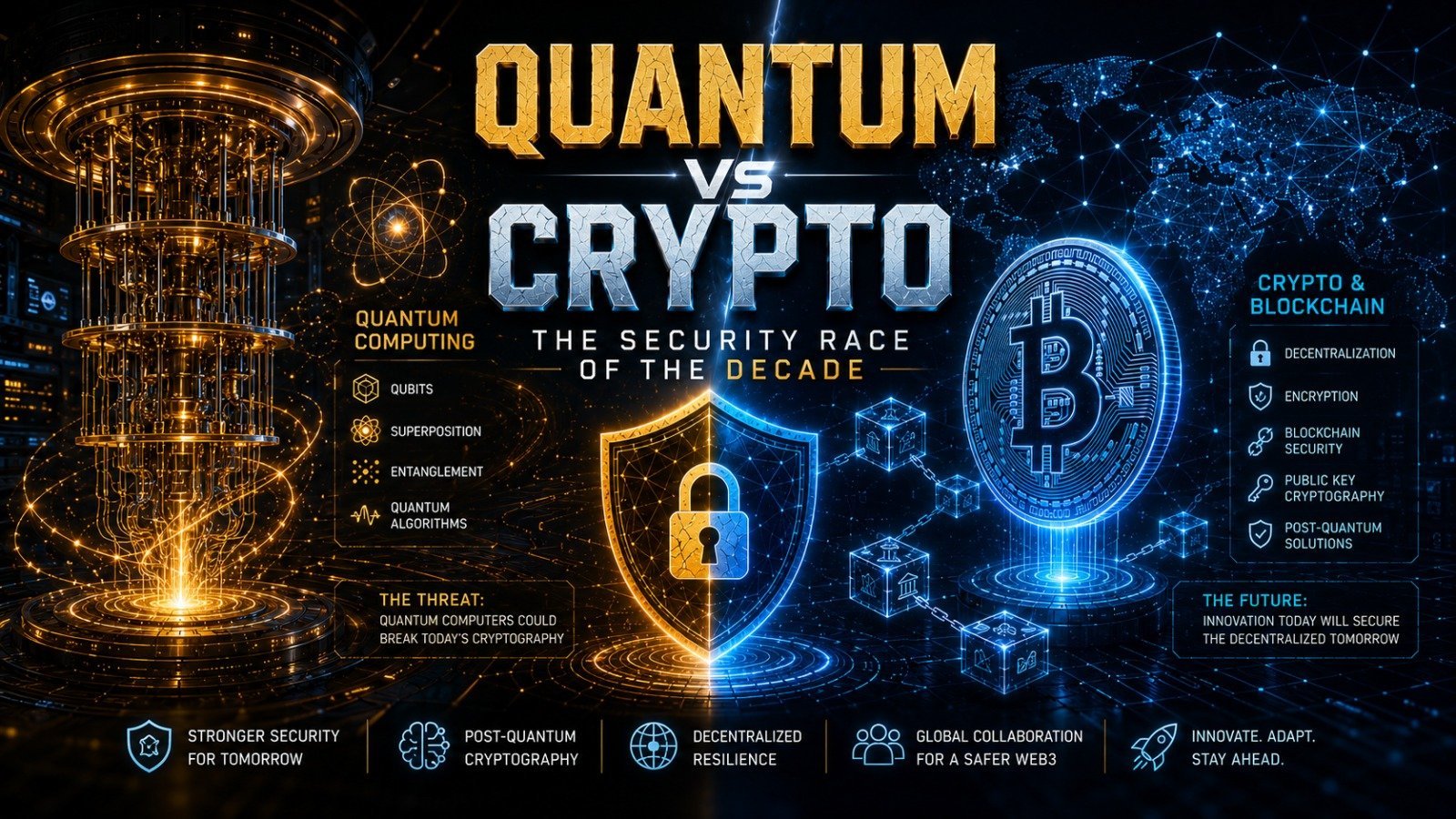
Quantum vs Crypto: The Security Race of the Decade
On June 22, 2026, the U.S. government put a hard date on a threat cryptographers have been warning about for over a decade. The order didn't invent the quantum threat — it just made the deadline real, for the government and, indirectly, for everyone holding Bitcoin.
For years, "quantum computers will break encryption eventually" has been the kind of warning that's technically true and easy to ignore, because "eventually" had no date attached. That changed this year. Between a finalized set of federal cryptography standards, a presidential executive order with a 2030 deadline, and a Bitcoin developer community that's already shipped code in response, the timeline went from theoretical to scheduled in the space of about eighteen months.
What quantum computing actually threatens
It's worth being precise here, because this gets oversimplified constantly. A powerful enough quantum computer does not threaten Bitcoin's proof-of-work mining (SHA-256 hashing is considered quantum-resistant for the foreseeable future). What it threatens is the digital signature scheme — ECDSA — that proves you own the Bitcoin in a given address and authorizes you to spend it. Ethereum relies on the same underlying mathematics. In theory, a sufficiently powerful quantum computer could work backward from a public key, which is often visible on-chain, to derive the private key behind it — and from there, spend funds that aren't yours.
This is the same elliptic-curve and RSA-based cryptography that underpins most of the internet, not just crypto: HTTPS, VPNs, digital signatures on contracts, and government communications all lean on math that a cryptanalytically relevant quantum computer (the field's term for a machine actually capable of this) would break. Crypto just happens to be a particularly visible case, because blockchains are public ledgers — the data an attacker would need is sitting in the open, forever, by design.
The deadline just got real
NIST finalized its first three post-quantum cryptography standards in August 2024 (known as FIPS 203, 204, and 205), giving the industry quantum-resistant replacements for the math currently in use. Its published transition plan calls for deprecating quantum-vulnerable algorithms by 2030 and disallowing them entirely by 2035.
What changed in 2026 is enforcement. On June 22, the President signed two executive orders — EO 14409 and EO 14411 — that turn NIST's guidance into a binding federal timeline: agencies must pilot post-quantum migration by the end of 2027, and complete migration of high-value systems for key establishment by December 31, 2030, with digital signatures following by the end of 2031. Federal contractors are now expected to fall in line on a similar schedule. The European Union has its own version of this clock: member states were asked to have migration roadmaps in place by the end of 2026, with high-risk systems moved by 2030.
The risk that matters today isn't "quantum computers exist now"
The realistic near-term danger has a name: harvest now, decrypt later. A quantum computer capable of breaking current encryption doesn't need to exist today for today's data to be at risk — an adversary can simply intercept and store encrypted traffic now, and decrypt it years from now once the hardware catches up. For anything that needs to stay private for five-plus years — government records, trade secrets, long-term financial data — that data is arguably already exposed the moment it crosses an unprotected network, regardless of when the decrypting machine actually arrives. It's the main reason migration is being pushed now rather than whenever the first capable quantum computer is confirmed to exist.
Bitcoin's own response is already underway
This isn't a hypothetical future problem for Bitcoin developers — it's an active one. Roughly 34% of all Bitcoin supply, an estimated 6.5 to 6.9 million coins, currently sits in address types that expose a public key on-chain, making them the vulnerable category if a capable quantum computer ever arrives. That includes an estimated 1.7 million BTC sitting in old "pay-to-public-key" addresses widely attributed to Bitcoin's creator, untouched since the earliest days of the network.
In response, Bitcoin Improvement Proposal 360 (BIP-360), introducing a new quantum-resistant address format, was merged into Bitcoin's official proposal repository in February 2026. BIP-361, a three-phase plan for migrating the network and eventually sunsetting legacy address types, followed in April 2026 — both built on the same NIST-approved cryptographic primitives the federal government is now mandating elsewhere. The work is real and already moving. Whether the wider Bitcoin-holding public actually migrates old coins to the new address types before it matters is a separate, harder question — one with a lot of history suggesting that "users update their wallets promptly" is the part that usually lags.
What to actually do with this information
- If you hold Bitcoin in an old address type (especially anything from the early years of the network), it's worth understanding whether your wallet uses an address format that exposes your public key, and watching for wallet-level support for the new quantum-resistant formats as they roll out.
- If you run any kind of online business or service — including, frankly, a site like this one — the practical takeaway isn't panic, it's awareness: the cryptographic standards underneath HTTPS, password storage, and digital signatures are entering a multi-year transition, and "my hosting provider and CMS handle that" is a reasonable answer today, as long as you eventually confirm they're actually doing it.
- If none of this applies to you directly, the honest takeaway is still that the foundational math behind digital trust — the thing Book 1 in this series is built around — is undergoing its first real planned replacement since public-key cryptography was invented in the 1970s. That's a genuinely significant moment in the history of the technology, independent of any one coin's price.
Start at the foundation
Cryptography 101 — The Language of Secrets
The hashing, encryption, and digital signature concepts this entire quantum story is actually about — explained from first principles, no prior knowledge assumed.
View this book →For the practical security habits that matter regardless of what quantum computing does next, Cybersecurity Essentials covers the everyday defenses worth having in place either way.