
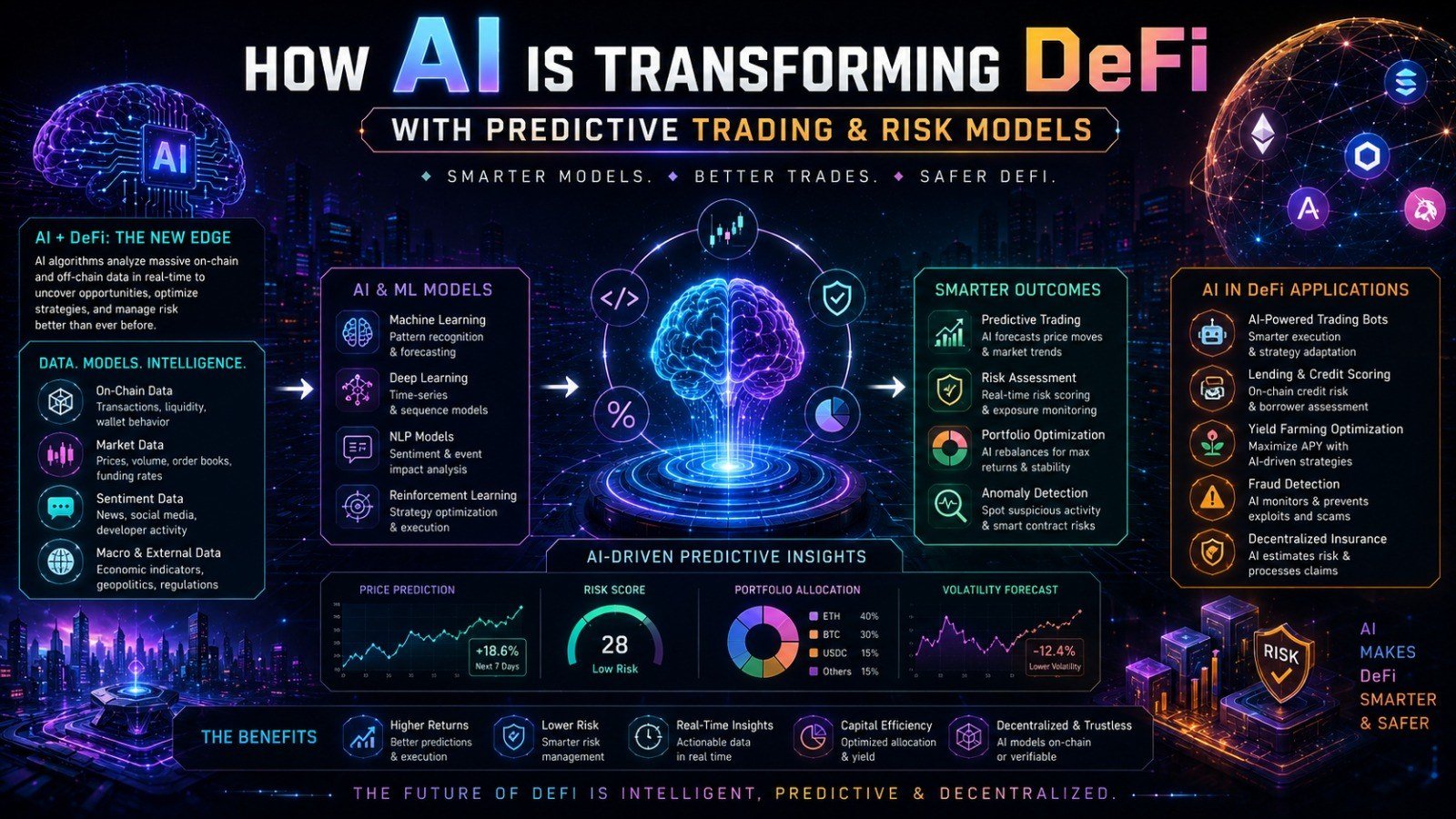
How AI Is Transforming DeFi: Predictive Trading and Risk Models
For most of DeFi's history, protocols found out they had a risk problem the same way everyone else did: after a crash, after a liquidation cascade, after the postmortem thread. That's starting to change. A handful of AI-driven risk platforms now sit underneath some of DeFi's largest protocols, working to spot the crisis before it fully arrives rather than explain it afterward.
Blockchains are an unusually good training ground for this kind of modeling, for a structural reason: on-chain data is transparent and permanent by default, in a way traditional finance's data almost never is. Every trade, every liquidity move, every wallet's behavior is sitting in the open, which makes DeFi one of the richest real-time datasets in finance for a model to learn from — and a meaningful part of why AI adoption here has moved faster than the "DeFi is unregulated and slow to professionalize" narrative would suggest.
From dashboards to actual risk management
AI's entry into DeFi started small: dashboards and analytics tools quietly monitoring protocol health and modeling user behavior in the background. It has since become something closer to active infrastructure. Gauntlet, one of the more established players, runs agent-based simulations to model how users behave under different economic scenarios and now formally advises major lending protocols including Aave, Compound, and Synthetix on parameter changes — the kind of risk-management role a traditional bank's quant team would play, run instead as an external, model-driven service for decentralized protocols.
What "predictive, not reactive" actually looks like
The shift shows up in a handful of concrete tools rather than one big idea. Predictive liquidation modeling helps protocols hedge volatile collateral positions before a price crash actually triggers a cascade of forced liquidations, rather than scrambling to absorb the damage afterward. Anomaly detection in smart contract behavior flags fraud-adjacent irregularities — an unusual sequence of contract calls, a sudden change in a pool's behavior — often before any user notices anything is wrong. Sentiment and wallet-cluster tracking watches social sentiment alongside on-chain whale behavior to anticipate liquidity shifts before they show up in price. None of these tools eliminate risk; what they change is the shape of it, giving protocols and sophisticated users a window to react that simply didn't exist when the only signal was the price chart itself.
The fraud-detection side is just as active
Beyond protocol-level risk, firms like Chainalysis and TRM Labs apply machine learning across decentralized ecosystems specifically to flag suspicious wallet behavior, detect money-laundering patterns, and in some cases predict an exit scam before it fully unfolds — work that increasingly underpins both exchange compliance teams and the due-diligence process institutional investors now expect before allocating capital to a protocol.
DeFi meets the agent economy: DeFAI
2025 and 2026 have seen the rise of what some in the industry call DeFAI — DeFi plus AI — where large language models replace manual transaction signing with intent-based, natural-language execution. Through platforms like Hey Anon and Griffain, a user can type an instruction like "rebalance my portfolio into high-yield stablecoins across three chains" and have an AI agent translate that directly into the sequence of on-chain transactions needed to do it, without the user manually navigating each protocol's interface. It's the same intent-based pattern showing up across the wider AI-agent economy, applied specifically to managing a DeFi position.
What this doesn't fix
- A prediction tool is not a guarantee. AI-driven risk models reduce surprise; they don't eliminate volatility or remove the possibility of a model being wrong at exactly the wrong moment.
- Concentration risk shows up in a new place. If a handful of AI risk platforms end up advising most of DeFi's largest protocols, a blind spot in one model's assumptions becomes a shared blind spot across the ecosystem — a version of the same concentration concern that shows up elsewhere in this technology's evolution.
- Smart contract risk and AI risk now overlap. An AI-driven market-making or risk-adjustment system is itself code, and inherits the same smart-contract security questions — bugs, exploits, adversarial manipulation — that any other DeFi protocol has to defend against.
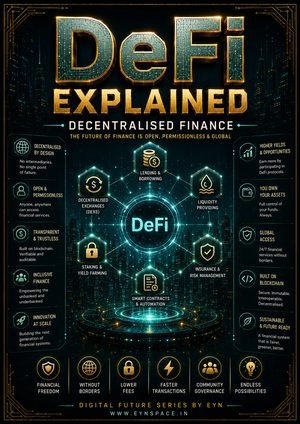
The foundation underneath every tool in this post
DeFi Explained — Decentralised Finance
Lending, borrowing, and trading without a bank only make sense once you understand the mechanics underneath — and the real risks behind the yields, AI-monitored or not.
View this book →For where autonomous agents fit into this same picture, The Future of Money looks at AI, blockchain, and finance converging at the system level.