
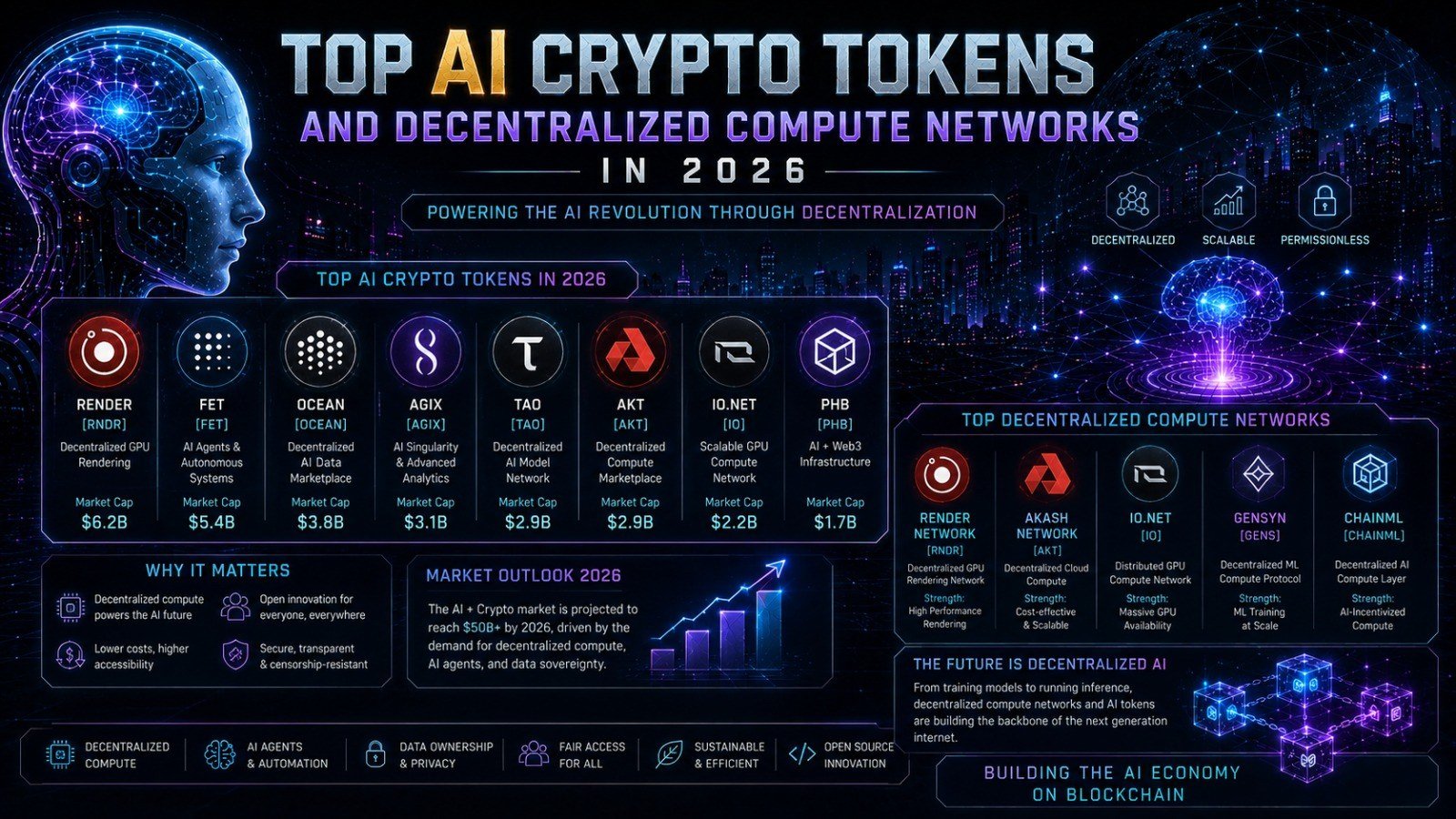
AI Crypto Tokens and Decentralized Compute Networks: What's Actually Out There in 2026
The AI-crypto sector has gone from a speculative niche to a real, if volatile, multi-billion-dollar category — built mostly on one straightforward economic idea: training and running AI models takes enormous amounts of GPU power, and that power is currently concentrated in the hands of a few cloud providers.
Decentralized compute networks exist to challenge that concentration by letting anyone with spare GPU capacity rent it out, and AI-token investors have piled in accordingly. Market capitalization figures in this sector move fast and vary a lot depending on the date and the data source you check, so treat any specific number here as a snapshot rather than a current quote — the point of this post is the landscape and the mechanics, not a price chart.
The four layers this sector actually splits into
It's easy to lump every "AI token" together, but they sit at genuinely different layers of the stack, and which layer a token belongs to matters more for understanding it than its ticker or its 30-day chart.
Infrastructure and compute is the largest category by market share. Render Network turns underused GPU capacity — originally aimed at 3D rendering — into a marketplace, with real partnerships including an integration with Apple's Metal framework. Akash Network runs a Cosmos-based reverse-auction marketplace for cloud compute generally, positioning itself as a cost-cutting alternative to AWS, with tens of thousands of active leases reported in late 2025. Bittensor takes a different approach: rather than just renting raw compute, it runs over a hundred specialized "subnets" where contributors compete to provide the best machine-learning output in a given domain, with rewards distributed based on quality.
AI agent platforms tokenize and monetize autonomous software agents directly. Virtuals Protocol, built on Coinbase's Base network, lets anyone launch an agent that earns its own revenue and trades against the platform's token. The Artificial Superintelligence Alliance — formed by the 2024 merger of Fetch.ai, SingularityNET, and Ocean Protocol — pursues a similar goal at a larger scale, aiming to build open-source infrastructure for autonomous economic agents.
Data marketplaces like Ocean Protocol let data owners monetize access to their datasets for AI training without giving up ownership — a model some are calling "data farming." General-purpose platforms with AI-specific tooling, like NEAR Protocol and Internet Computer, round out the sector by offering the broader blockchain infrastructure AI applications run on top of.
The line between "AI token" and "DePIN token" is disappearing
DePIN — decentralized physical infrastructure networks — originally referred to tokens incentivizing real-world resource contribution generally: compute, bandwidth, storage. AI demand has been so dominant that most major DePIN projects, including Render and io.net, now serve AI workloads as their primary use case, which has effectively merged the two categories in practice even where the labeling hasn't caught up.
What's separating the durable projects from the noise
Industry analysts converge on a few practical filters worth applying to any project in this space: does it have real, measurable on-chain activity (GPU jobs actually dispatched, models actually trained) rather than just a roadmap; is there active, visible developer activity on its codebase; and is it being adopted by parties outside the existing crypto-native community, since that's a much stronger signal than internal enthusiasm. The sector's own history is a useful caution here — a wave of "AI-branded" tokens with little underlying infrastructure rose and fell during the 2024 mania, and the projects that held or recovered ground afterward were disproportionately the ones with real usage behind them.
The honest risk picture
- Quality of service is unproven at enterprise scale. Distributed, anyone-can-join GPU networks face real questions about uptime guarantees, latency consistency, and security certification that centralized providers have spent years building out.
- This remains one of the more volatile corners of an already volatile asset class. Token prices in this sector have swung by double-digit percentages within single months, and several prominent agent-economy tokens have traded more than 80% below their all-time highs while the underlying narrative was still considered intact.
- "AI" in a token's branding is not a fundamentals check. The honest version of this sector is a genuine infrastructure response to real GPU scarcity; the inflated version is a wrapper applied to projects with no real usage behind them. Telling the two apart takes the same due diligence any other crypto investment requires.
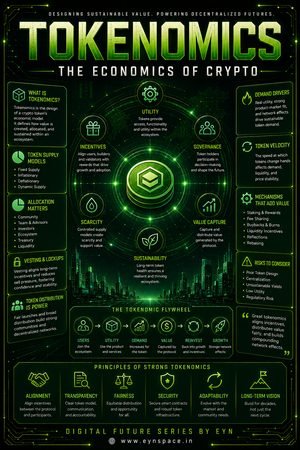
Understanding what actually drives a token's value
Tokenomics — The Economics of Crypto
Supply, allocation, and incentive design are what separate a token tied to real usage from one tied only to a narrative. This book is the framework for telling the difference.
View this book →For the broader landscape these tokens operate in, Altcoins Uncovered covers how to evaluate any coin beyond Bitcoin on its own merits.