
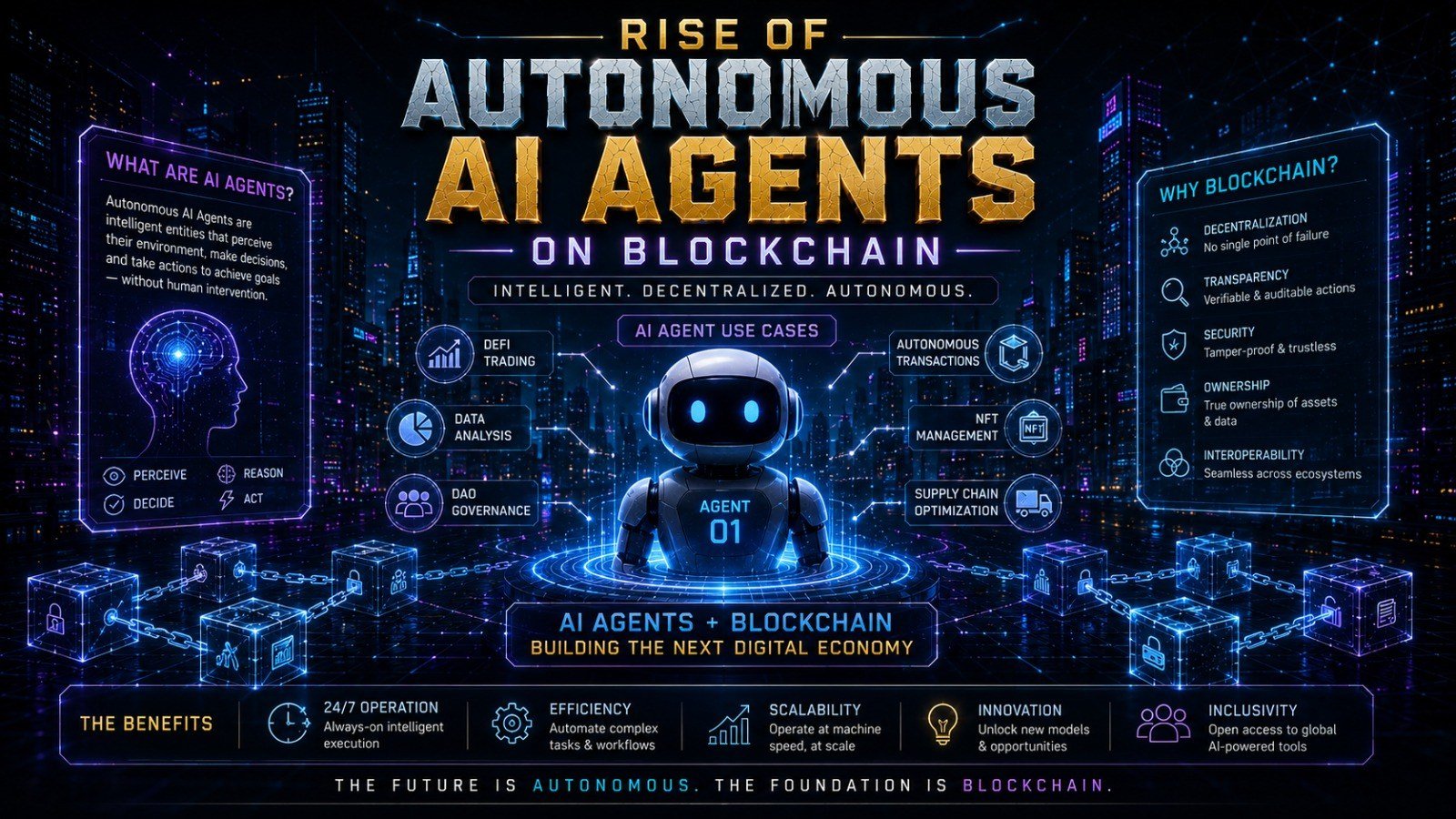
The Rise of Autonomous AI Agents on Blockchain
Software that holds its own wallet, pays for the services it needs, and executes financial decisions without a human approving each step sounds like a 2030 prediction. It is already running, in production, in 2026 — and the reason it lives on blockchain rails rather than traditional banking infrastructure is mostly mundane: banks were never built to open accounts for software.
An AI agent, in the sense that matters here, is autonomous goal-driven software that can perceive information, reason about it, and act — not a chatbot, and not a simple rule-based bot. Give that kind of system the ability to hold funds and sign transactions, and you get something genuinely new: machine-native economic activity that doesn't route through a human at the point of execution.
Why agents need crypto rails specifically
Traditional financial infrastructure assumes a human identity behind every account: a bank wants a person or a legal entity, identity verification, and a relationship it can hold accountable. None of that fits software that needs to transact thousands of times a day, autonomously, possibly across borders, often for amounts too small to justify a bank's overhead. Public blockchains solve this by letting any wallet — human or software — directly custody assets and execute programmable agreements. An AI agent with a wallet doesn't need a bank's permission to exist; it just needs a private key and code that knows how to use it.
How agents actually transact, without exposing their entire wallet
The infrastructure that makes this safe rather than reckless has matured fast in 2026. Account abstraction standards like ERC-4337, combined with Ethereum's newer EIP-7702, let a human grant an agent scoped, temporary permissions — "you may spend up to this amount, on these contracts, for this window of time" — rather than handing over master keys. Instead of writing out detailed transaction logic, many agents now operate through intent-based execution: the agent declares the outcome it wants (rebalance this portfolio, liquidate this position), and a separate network of "solver" nodes competes to actually route and execute the trade most efficiently. Machine-to-machine payment protocols are the other major piece — Coinbase's x402 protocol, for instance, lets an agent pay for an API call or a dataset per request, in stablecoins, over standard web infrastructure, without ever setting up a traditional billing account.
What agents are actually doing on-chain right now
The use cases that have moved past pilot stage in 2026 include autonomous DeFi portfolio managers that rebalance holdings based on live on-chain signals, compliance agents that screen wallets for sanctions exposure and transaction risk in real time, cross-chain arbitrage agents that need market data across multiple networks simultaneously, and natural-language portfolio tools — through platforms like Hey Anon and Griffain — that let a user type something like "move my holdings into stablecoins across three chains" and have an agent translate that into the actual sequence of transactions.
The guardrails this only works with
None of this is being deployed with blind trust in the underlying model. The enterprise pattern that's emerged in 2026 treats an agent as an operator with deliberately constrained authority rather than an all-powerful signer: per-transaction and daily spending caps, allowlists restricting which contracts and counterparties an agent can interact with at all, human-readable audit logs linking every on-chain action back to the decision that triggered it, and emergency circuit breakers that can pause an agent the moment its behavior looks abnormal. Security and regulation are both still playing catch-up to agent capability, which is the honest caveat underneath all of the growth numbers above — the infrastructure for letting agents transact has outpaced the infrastructure for proving, after the fact, that a given agent's decision was sound.
What to watch from here
- Agent wallets as their own product category. Wallet infrastructure built specifically for autonomous software — rather than retrofitted human wallets — is now a distinct, funded space, with providers like Coinbase's Developer Platform competing directly for it.
- Volume is the metric that matters more than headlines. The clearest signal that this is real rather than narrative is transaction volume flowing through agent-specific payment rails, which has been growing in the hundreds of millions annually rather than staying flat.
- The accountability question is still open. When an autonomous agent executes a bad trade or violates a compliance rule, the audit trail exists — but who bears responsibility, and how liability gets assigned between the agent's operator, its developer, and the platform it ran on, is still being worked out case by case rather than by settled law.

Where this convergence is actually heading
The Future of Money
Autonomous agents transacting on-chain are a preview of exactly the convergence this series finale maps out — AI, blockchain, identity, and regulation, all colliding at once.
View this book →For the smart-contract mechanics underneath every agent transaction described here, Ethereum & Smart Contracts covers the programmable-money layer this entire field runs on.